15. The Palace of St Michael and St George
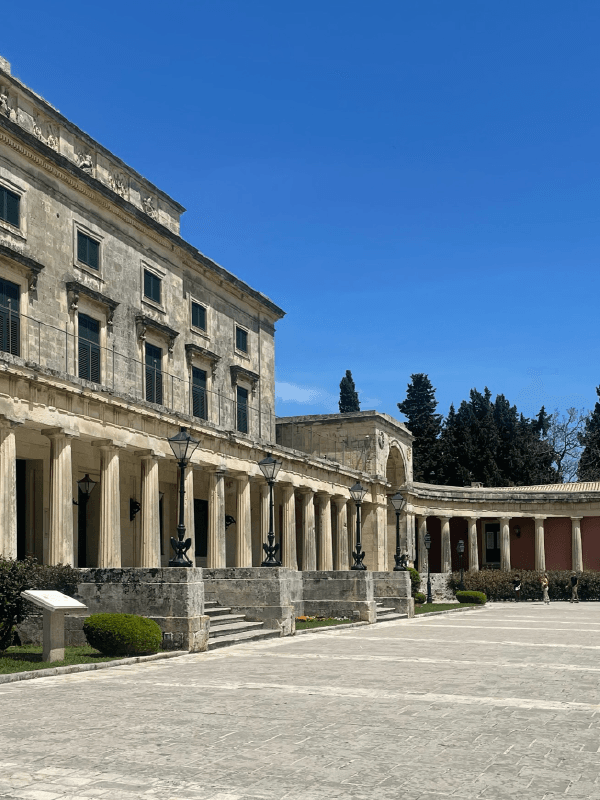
Τhe second-largest palace in Greece
01.The High Commissioner’s grand designs
You are at the top of Spianada Square, in front of the Palace of Saints Michael and George. Its history began in 1819, during the British Protectorate, when the first British High Commissioner of the Ionian Islands, Thomas Maitland, decided that his residence in the Old Fortress was not impressive enough and so requested that a new, grander residence be constructed to the north of Spianada Square.
The official reason for the construction of the palace was to become the seat of the headquarters of the Order of St Michael and St George (one of the most prestigious British honours, awarded to those holding high position in Mediterranean territories), which was transferred to Corfu. It also housed the Ionian Senate and Parliament which, together, defined the government of the Ionian State.
02.A palace fit for a king
The Palace of St Michael and St George was completed in 1823 according to the designs of Sir George Whitmore, a general and member of the Royal Engineers, becoming the largest palace in Greece after the residence of King Otto (now the Hellenic Parliament).
The Regency style (which was the last phase of the Georgian-style of architecture) can be seen in the Doric columns forming the front colonnade, with two symmetrical, arched gates (of St Michael and St George). Inside, you can see the Conference Room of the Ionian Senate and Parliament, as well as the Hall of the Order of St Michael and St George, the circular Reception Hall, the Banquet Room and the Throne Room.
03.Who actually got to live there
Thomas Maitland, who was widely resented in Corfu for his authoritarian ways, never got to stay in the palace before he died in 1824. He was succeeded as Lord High Commissioner by Frederick Adam, who commissioned the construction of public buildings and improved the water supply system. Adams’ work was much appreciated by the islanders and it is his statue (created by local sculptor Pavlos Prosalendis) that now adorns the garden in front of the palace.
04.From royal palace to Museum of Asian Art
After Corfu’s union with Greece in 1864, the palace became a residence of the royal family. Today, it houses the Museum of Asian Art, the only museum in Greece devoted exclusively to the art and antiquities of Asia, with some 15,000 artefacts.
It was founded in 1928, following the donation of an impressive collection of art from China, Japan and Korea by a former Greek Ambassador to Austria, Gregorios Manos. It has since grown to include works from India, Pakistan, Tibet, Siam and elsewhere in South East Asia.
Exhibits include Samurai armour and objects used by Geishas and from Japanese Tea Ceremonies, as well as Chinese porcelains from the prehistoric dynasties to the long-lasting porcelains of the Ming and Qing dynasties.
05.Tip
You can listen to Discover Greece podcasts on Spotify, including our episode about Corfu’s Museum of Asian Art.
06.Directions
Head through the monumental gate to the left of the palace as you face it (known as the Gate of Agios Georgios or Saint George). Vehicles are allowed to pass through this gate on Kapodistriou St (unlike the other one, to the right of the palace). Follow Kapodistriou St for about 50 meters until you see a corner building on your left, with four arches and a side staircase leading up to the door.

